
Kandiyohi Jail Release Path
Kandiyohi County Jail is a receiving county jail. A Stevens County payment packet records an April 2026 prisoner-placement and medical payment to the Kandiyohi County Sheriff. That is solid evidence of recent use, but it is not proof of permanent placement or proof that a named detainee went there. Stevens County has no licensed jail and can use more than one receiver. Begin with the Stevens Sheriff's transport record.
If Kandiyohi held the person, Kandiyohi created the physical admission, custody, and departure data. Stevens still owns its originating booking and transfer information. A community release can follow bond, recognizance, time served, dismissal, or another court disposition. Movement to Minnesota DOC, another jail, or a federal authority is a transfer. It ends Kandiyohi custody but not all custody.
Search Kandiyohi Jail Custody
The Kandiyohi custody list is timestamped and rich in fields. It can display a photograph, master-name index number, booked name, sex, age, booking number, intake date, charges, bail or bond, and sometimes a calculated outdate. Those details help confirm identity and plan the next check. They do not convert the list into a historical Stevens release feed.
- Ask Stevens County whether Kandiyohi received the person and on what date.
- Open the timestamped Kandiyohi list and compare the name, intake details, charges, and booking number.
- Search Minnesota VINE and compare the named holding agency and offender identifier.
- Treat a calculated outdate as an estimate, not as proof that departure occurred.
- When the name disappears, request Kandiyohi's release or transfer entry.
- Compare that event with the Stevens court register and the Sheriff's originating record.
The broader Stevens County released-inmate search explains when to move to Minnesota DOC, federal, or court channels. Each tool answers a different part of the chain.
Note: Record the custody-list timestamp because the list can change, while the agency's retained release log may remain available by request.
Kandiyohi Calculated Outdate
A calculated outdate is useful but limited. It reflects a projected custody endpoint based on information then in the system. It may change after court action, jail credit review, disciplinary action, a hold, or a transfer decision. It is not the same as an executed release date and time.
| Kandiyohi field | What it supports | What it cannot prove |
|---|---|---|
| Page timestamp | When the custody view was generated | Later status |
| Booking number | Identity of the local admission | Final disposition |
| Intake date | Start of the displayed jail event | Release date |
| Bail or bond | Terms shown during custody | That bond was posted |
| Calculated outdate | Estimated endpoint | Executed community release |
After the estimated date passes, check the live list again and contact the jail. If the person entered Minnesota DOC custody, the DOC Public Viewer becomes the ongoing status source. If a different jail received the person, seek that receiver's record.
Kandiyohi Release Record Request
The research does not provide a verified Kandiyohi records-unit address, phone, or public hours. Those unknowns should not be guessed. Use the official custody page and county channels to locate and confirm the current records contact before sending a request.
Receiving county jail operated by Kandiyohi County
Verify the current records contact through official Kandiyohi County channels.
Supply the full booked name, Kandiyohi booking number if shown, intake date, Stevens case or incident number, and the known transfer period. Ask for the maintained departure date and time, disposition code, legal basis, and receiving authority. If any field is withheld, request the statutory basis and all public portions that can be separated.
Minnesota Statutes section 13.82 identifies specified adult arrest, transfer, and release data as public. That does not make every jail file public. Active investigative, juvenile, medical, security, sealed, or victim data may have limits. A narrow request seeks the public custody event without demanding unrelated protected material.
Kandiyohi Release Evidence
A reliable finding reconciles four layers. Stevens confirms its processing and destination. Kandiyohi confirms the physical jail event. VINE supplies a custody-change lead. The court register provides the order or case disposition. These records may update at different times, so apparent conflict often reflects timing rather than error.
| Source | Best use |
|---|---|
| Stevens Sheriff | Originating booking, transport date, and destination |
| Kandiyohi custody list | Current physical-custody snapshot |
| Kandiyohi release log | Executed release or transfer from the jail |
| Minnesota VINE | Custody-status and change notification lead |
| Stevens court case | Legal authority, conditions, sentence, or later warrant |
Preserve exact labels. “Released” may describe departure from Kandiyohi. “Transferred” names continued custody. “Calculated outdate” is a forecast. A court release order may precede administrative departure.
Note: When dates differ, ask each agency which event its timestamp measures rather than choosing one record without explanation.
Kandiyohi ICE Record Caution
Kandiyohi has had a separate immigration role, but that history does not prove a Stevens-origin detainee has an ICE matter. Do not infer an immigration hold from the facility name, a missing roster entry, or a person's birthplace. Require a person-specific hold or transfer record.
If Kandiyohi transferred a person to ICE, request the date, time, legal basis, and receiving agency. That event is departure from county-jail custody, not release to the community. The ICE Online Detainee Locator is mainly a current-custody tool and is not a full historical release database. A no-result can reflect timing, spelling, identity details, age rules, custody elsewhere, or an actual departure.
This receiver-specific distinction prevents a serious category error. The county release record should state what Kandiyohi did. ICE custody, if present, must be verified in the federal system.
Kandiyohi Custody Terms
The field names point to different stages. They should not be collapsed into one generic release date.
- Intake date
- The start of the Kandiyohi booking or admission shown on the current list.
- Calculated outdate
- A projected endpoint, subject to change and later execution.
- Transfer
- Movement to a new custodian without community release.
- Release
- Departure under the disposition recorded by the jail.
- Detainer
- A request or legal basis for another authority to hold or receive the person.
Ask Kandiyohi to define any code used in the actual record. The source label carries more weight than an outside paraphrase.
Kandiyohi and Stevens Records
Two requests are often needed because the counties created different facts. Stevens can provide the booked identity, incident, arresting agency, transport time, and named receiver. Kandiyohi can provide its admission identifier, custody status, and physical departure event. The court can show bond, release conditions, sentencing, dismissal, probation, revocation, or a warrant.
Ask whether the Kandiyohi departure was community release, court transport, state commitment, another county transfer, federal pickup, or some other disposition. Then verify the next system when custody continued. This precise language is the best way to find where someone went after the name left the current list.
Note: A Stevens payment to Kandiyohi supports the facility map, but individual placement still requires a name-specific record.
Kandiyohi Custody List View
The official Kandiyohi custody list provides the receiver-specific screen documented in the manifest.
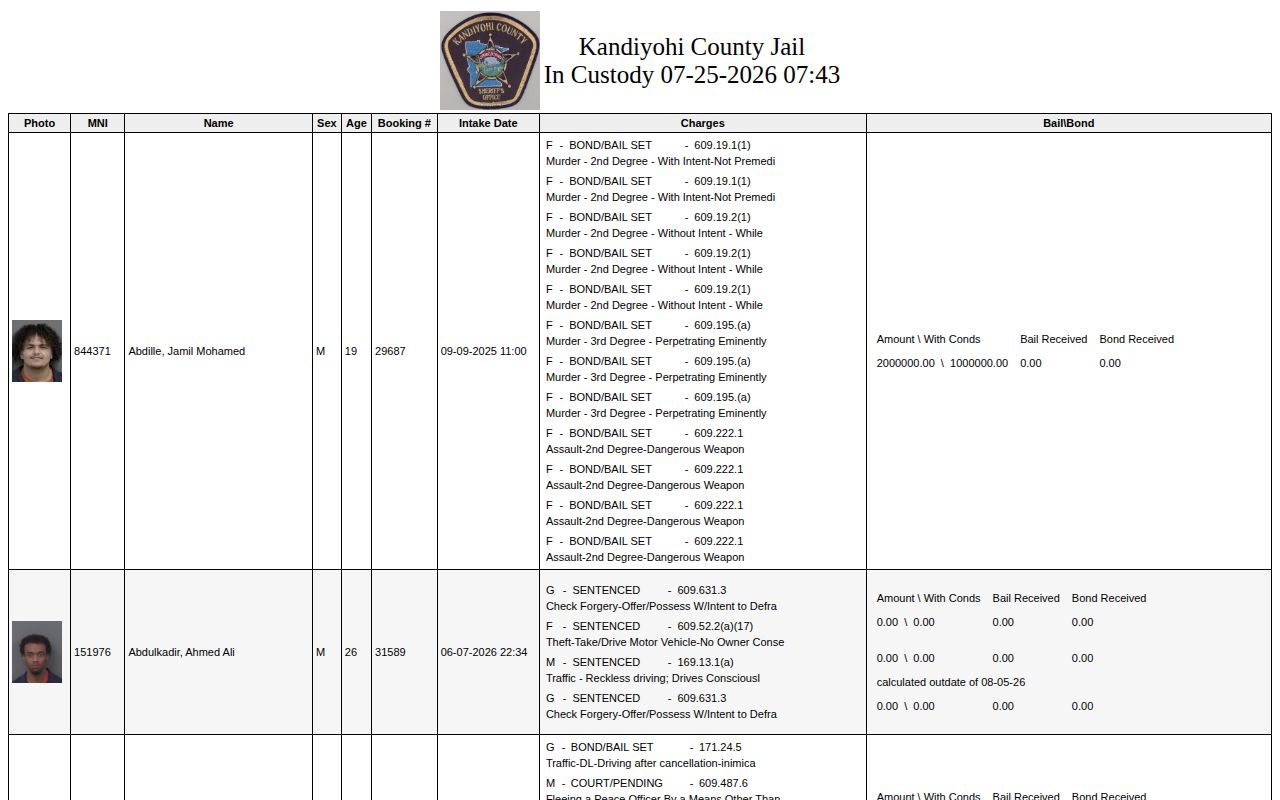
The captured list shows why the timestamp, booking number, intake date, and calculated outdate must remain separate. It is evidence of the screen at one moment, not evidence that an estimated exit later occurred.
Kandiyohi's greater field depth makes identity comparison easier than a name-only result. Match the MNI and booking number when available, then compare intake date, charge, and arresting agency with the Stevens record. A photograph can help distinguish records, but it does not show present custody after the page timestamp. Likewise, bail or bond displayed on the list states terms in the system, not proof that payment was made or release completed.
When the entry disappears, request Kandiyohi's final event with the same identifiers. Ask whether a new jail, Minnesota DOC, court transport, or another authority received the person. If the response mentions an immigration transfer, seek the person-specific hold and receiving agency. Kandiyohi's separate immigration role is not enough to infer such a transfer for any Stevens detainee.
The court and receiving jail may record different times because they measure different events. The court entry records legal action. Kandiyohi records operational execution. Stevens records its own transport and case link. Keeping all three timestamps makes the final account accurate and explains a gap without guessing.
Kandiyohi Release Code Check
Request field definitions if the Kandiyohi departure uses a short code. Preserve that code beside any plain-language explanation, since similar terms may carry different operational meanings across receiving counties and systems.